Small Bedroom Decorating Ideas to Make Your Space Feel Bigger
Struggling with a tiny room? Discover brilliant small bedroom decorating ideas to make it feel bigger and more functional. Get expert tips and transform your space into a stylish retreat now!
By Roomellow Team
The smallest bedrooms often present the biggest design challenges. It's a common story: you move into a new place, or just look around your current one, and realize that your sleeping space feels more like a closet than a calm retreat. I’ve been there, staring at a wall a foot too close to my bed, wondering how on earth to fit anything else in without feeling like I’m sleeping in a sardine can.
The good news? A small bedroom doesn't have to feel cramped or uninspired. In fact, it's often an opportunity for some of the most creative, efficient, and deeply personal design. The key isn't to magically make it bigger, but to make it feel bigger, more functional, and utterly reflective of you, all while navigating real physical constraints. It’s about being deliberate with every single choice, because in a small space, every square inch and every visual line matters.
Here's how to turn that tight spot into a smart, stylish, and supremely comfortable personal haven.
1. Optimize Your Bed Choice and Placement
Your bed is, without question, the largest piece of furniture in a small bedroom, and it dictates the layout of everything else. This isn't the place for an oversized, ornate king bed in a 9x10 foot room; you'll immediately regret it.
Choose the Right Size (Really)
If you're squeezing a queen into a room that only truly fits a full, you're starting off on the wrong foot. Measure your room meticulously and consider whether a full (54"x75") is truly more appropriate than a queen (60"x80"). If you’re furnishing a guest room or a child’s room, a twin XL (38"x80") can offer more legroom without the width of a full.
Embrace Storage Beds and Platforms
A bed that offers storage underneath is a non-negotiable for most small bedrooms.
- Platform beds with drawers: These are fantastic. Look for models from brands like Pottery Barn or even IKEA that offer built-in drawers directly beneath the mattress. This eliminates the need for bulky dressers, freeing up precious wall space. Expect to pay anywhere from $700-$2000 for a good quality storage platform bed.
- Lift-up storage beds: Some beds have a hydraulic lift mechanism, allowing the entire mattress base to be lifted, revealing a cavernous storage space beneath. These are often more expensive ($1000-$3000+) but offer unparalleled storage capacity, perfect for off-season clothing, extra bedding, or even luggage.
- Simple platform frames: If you're on a tighter budget or prefer a more minimalist look, a simple low-profile platform frame (like the Thuma bed, or similar styles from Zinus on Amazon) removes the need for a box spring and keeps the visual profile low, making the room feel less cluttered. You can then add under-bed storage bins yourself.
Strategic Placement
In most small rooms, pushing one side of the bed against a wall is the only viable option. While two nightstands are ideal, one is often enough. If you have to place the bed under a window, make sure your headboard isn’t too high, or opt for a no-headboard look entirely. I've designed plenty of compact bedrooms where the bed literally floats in the middle of the longest wall, leaving just enough clearance on either side for tight passage and slim nightstands. If you're dealing with a truly tiny space, consider a Murphy bed or a daybed that doubles as a sofa during the day to reclaim floor space.
2. Master the Art of Vertical Storage
When you can't build out, you build up. Every small bedroom needs to leverage vertical space effectively.
Tall and Narrow is Your Friend
Instead of a wide, low dresser that eats up half your wall, choose a tall, narrow dresser (sometimes called a "lingerie chest" or "tower dresser"). A 20-inch wide, 50-inch tall dresser offers significant storage without demanding a huge footprint. For example, West Elm often has sleek, tall dressers in their storage collections.
Wall-Mounted Shelving
Floating shelves are perfect for books, small decorative items, or even a charging station. Install them above your bed, over a doorway, or in an unused corner. The key here is not to overload them, as that can make the room feel busy and cluttered. A simple set of three 24-inch wide shelves can add both storage and visual interest. Consider slim picture ledges for displaying art or small decor without taking up depth.
Go Over the Door
An over-the-door shoe organizer or a set of hooks can provide storage for accessories, pajamas, or even handbags without using any floor space at all.
Embrace Multifunctional Furniture
- Nightstands with drawers: Skip the open-shelf nightstand unless you’re incredibly tidy. A nightstand with at least one drawer hides clutter immediately. Even better, a small chest of drawers can double as a nightstand, giving you extra storage.
- Desk/Vanity Combos: If you need a small desk, look for models with built-in drawers or shelves. A wall-mounted fold-down desk can also be a lifesaver, providing a workspace when needed and disappearing when not. For more ideas on how to furnish tricky small spaces, check out our guide to the best furniture for small apartments.
3. Play with Light and Color to Create Illusions
Color and lighting are powerful tools for manipulating perception. In a small room, they can be the difference between feeling claustrophobic and feeling expansive.
Light and Bright Walls
This is design 101 for a reason: lighter colors reflect light, making a room feel larger and airier. Stick to whites, off-whites, very light greys, or pale blues and greens. These cool tones tend to recede visually, pushing the walls away from you. My personal favorite is Benjamin Moore's "Chantilly Lace" or "White Dove" for a crisp, clean base. If you crave a little color, a very light sage green or a sky blue can be incredibly calming without shrinking the space. For more inspiration, delve into specific bedroom color ideas.
Layered Lighting is Essential
One overhead light is almost never enough and often creates harsh shadows.
- Ambient lighting: A flush mount ceiling fixture or a semi-flush mount is ideal for general illumination. Choose something sleek and close to the ceiling to avoid visual bulk.
- Task lighting: Instead of bulky table lamps on your nightstands, consider wall-mounted sconces. They free up surface area, making your nightstand feel larger and less cluttered. You can find beautiful plug-in sconces from stores like West Elm or even Amazon for around $50-$200 each. If sconces aren't an option, a slim floor lamp with a small base can work beside the bed or in a corner.
- Accent lighting: A small lamp on a dresser or a strip of LED lights behind your headboard can add warmth and depth without taking up much space.
Mirrors Are Not Just for Checking Outfits
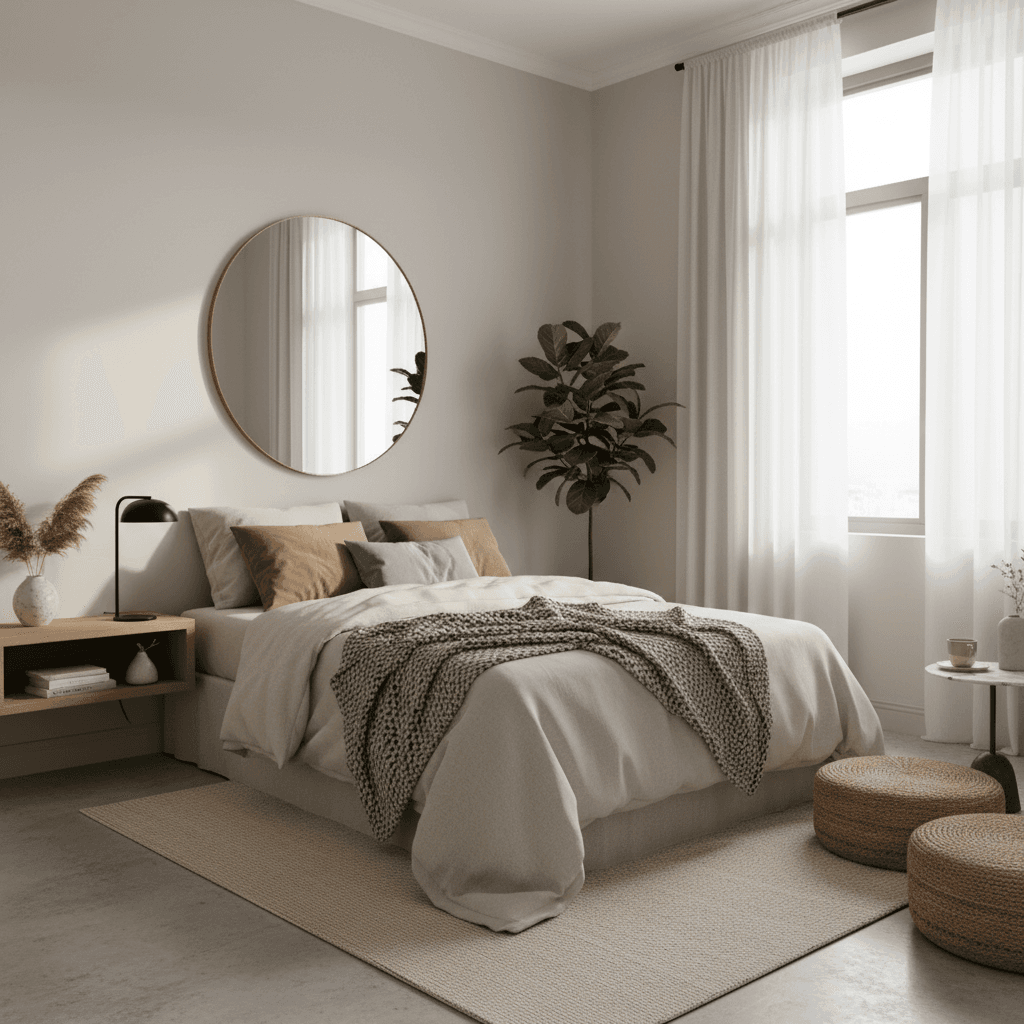
Strategically placed mirrors can work wonders. A large mirror leaning against a wall (secure it with wall anchors!) or a full-length mirror hung opposite a window will reflect light and views, effectively doubling the perceived size of the room. A mirror above a dresser or desk can also create the illusion of depth. Just be careful not to place a mirror where it reflects clutter; you don't want to amplify mess.
4. Prioritize Scale and Thoughtful Placement
The biggest mistake people make in small rooms is filling them with appropriately small items. Sometimes, fewer, larger pieces actually make a space feel more intentional and less cluttered than many small, fussy ones.
Choose Pieces Proportionally
A gigantic armchair will overwhelm a tiny room, but so will a collection of three dinky chairs. Instead, choose one well-proportioned piece. Perhaps a narrow slipper chair in a corner, or a slim bench at the foot of the bed. Everything needs to "fit." If you have only 24 inches on either side of your bed, then your nightstands should be 18-20 inches wide, max.
Leave Breathing Room
Resist the urge to push every piece of furniture against the walls. Pulling a small armchair a few inches away from the wall can actually create a sense of depth. More importantly, ensure there's a clear pathway around the bed and to the door. You should be able to walk without bumping into furniture. This is where truly understanding your room's dimensions and the furniture's footprint becomes vital. For more guidance on optimizing compact living, explore our ideas for how to design a small living room, many principles of which apply to bedrooms.
Utilize Corners
Corners are often wasted space. A corner shelving unit, a small corner desk, or a floor lamp tucked neatly into a corner can make use of an otherwise awkward area.
5. Curate Your Decor and Textiles
This is where the "less is more" mantra truly shines in a small bedroom. Every decorative item needs to earn its spot.
Rugs: Go Big, Not Small
This might sound counter-intuitive, but a tiny rug floating in the middle of the room can make the space feel smaller and disjointed. Instead, choose a rug large enough that the bed sits entirely on it, or at least two-thirds of the bed (with the nightstands off the rug). A 5x7 or 6x9 rug is often appropriate for a full or queen bed, depending on the room dimensions. The rug anchors the space, adding warmth and defining the sleeping zone.
Drapes: Floor-to-Ceiling
Hang your curtain rod high and wide, as close to the ceiling as possible, and extending beyond the window frame. This draws the eye upwards, making the window and the room feel taller. Choose light, airy fabrics for curtains—think linen or sheer cotton—that allow light to filter in. Avoid heavy, dark drapes that can make the room feel heavy and enclosed.
Thoughtful Art and Decor
- One large piece of art: Instead of a busy gallery wall that can feel overwhelming, consider one impactful piece of art above your bed or on your largest wall. It creates a focal point without adding visual clutter.
- Minimalist decor: Choose a few meaningful objects to display. A beautiful vase, a stack of aesthetically pleasing books, or a small plant can add personality without overwhelming the space.
- Texture over pattern: While I love a good pattern, in a small space, too many can make it feel chaotic. Instead, layer different textures: a chunky knit throw, a linen duvet cover, a subtly textured rug. This adds depth and interest without visual noise.
6. Personalize Without the Clutter
Your bedroom is yours. It should reflect your personality and offer comfort. But in a small space, personalization needs a disciplined approach.
Choose Meaningful Items
Every item on display should have a purpose or significant meaning. This isn't the place for knick-knacks collected over the years unless they bring you true joy. If you have collections, consider rotating them or displaying only a select few.
Incorporate Greenery
A small plant (real or high-quality faux) adds life and a touch of nature. A snake plant, ZZ plant, or a pothos can thrive in various light conditions and takes up minimal space on a nightstand or shelf.
Color Pops Through Accessories
If you've kept your walls and furniture neutral, inject personality with pops of color in your throw pillows, a decorative blanket, or a piece of art. These are easy to swap out if you want a refresh, allowing your small space to evolve with your tastes.
Bringing Your Small Bedroom Dreams to Life
Designing a small bedroom can feel like a puzzle, but it's a deeply rewarding one. Each deliberate choice contributes to a more functional, beautiful, and serene space. You start with the constraints, but you end with creativity.
This is exactly where Roomellow comes in. You can upload a photo of your small bedroom and let our AI transform it with these principles in mind, using real furniture from various stores. Imagine seeing how a sleek storage bed, a pair of wall-mounted sconces, and a strategically placed mirror would look in your room before you buy anything. We help you visualize these impactful changes, making it easy to experiment with different layouts, colors, and furniture pieces to maximize your small space. It takes the guesswork out of design, showing you exactly how to make every square inch count.
Ready to redesign your room?
Upload a photo of your room and get a professional AI redesign with real furniture you can buy. Free to try — no credit card required.
Try Roomellow free