Furniture and Home Furnishings Store Sales Rose 4.9% in September 2026: Is the Market Recovering?
Furniture and home furnishings store sales rose 4.9% in September 2026. What's behind the gain, what prices, factory orders and the January tariff step add, and what to do before Thanksgiving weekend.
By Afroja Akter / Founder, Roomellow

On October 15, the U.S. Census Bureau reported that sales at furniture and home furnishings stores rose 4.9% in September 2026 compared with September 2025. It's the best headline the category has had all year.
Is the market recovering? Slowly, and by less than the headline suggests. Here's what the number says, what it leaves out, and what it means for a furniture store going into Thanksgiving weekend.
Published November 7, 2026, with the data available that day. When the October figures arrive, we'll add a dated update at the end rather than rewrite this analysis.
What Census Reported
In its advance monthly retail report, Census put September sales at furniture and home furnishings stores at $10.7 billion, seasonally adjusted:
- Up 1.3% from August.
- Up 4.9% from September 2025.
- Up 0.3% for July through September, compared with the same three months of 2025.
- Down 1.5% for January through September ($93.2 billion), compared with the same months of 2025, before seasonal adjustment.
Is the change real, or noise? Census publishes a typical (median) standard error for each kind of store, and a method for turning a standard error into a 90% range: the change, plus or minus 1.753 times the standard error. Using those median standard errors as an approximation (our analysis), the 1.3% monthly increase falls within a range that includes zero, roughly −1.7% to +4.3%. The 4.9% annual increase appears more clearly positive, at roughly +1.4% to +8.4%. These are approximate uncertainty ranges, not confidence intervals calculated from September-specific standard errors.
Why 4.9% Is Smaller Than It Looks
Part of it is a weak comparison. At $10.2 billion, September 2025 was the lowest month of 2025 in the Census monthly series, so part of the 4.9% increase reflects comparison with a relatively weak month. The year-to-date and quarterly figures give a more cautious picture of the recovery, even though this September was the strongest month since July 2025.
The trend is improving, slowly. Comparing each quarter of 2026 with the same quarter of 2025, sales went from down 3.7% to down 1.3% to up 0.3%: a category moving from shrinking to roughly flat, not a boom.
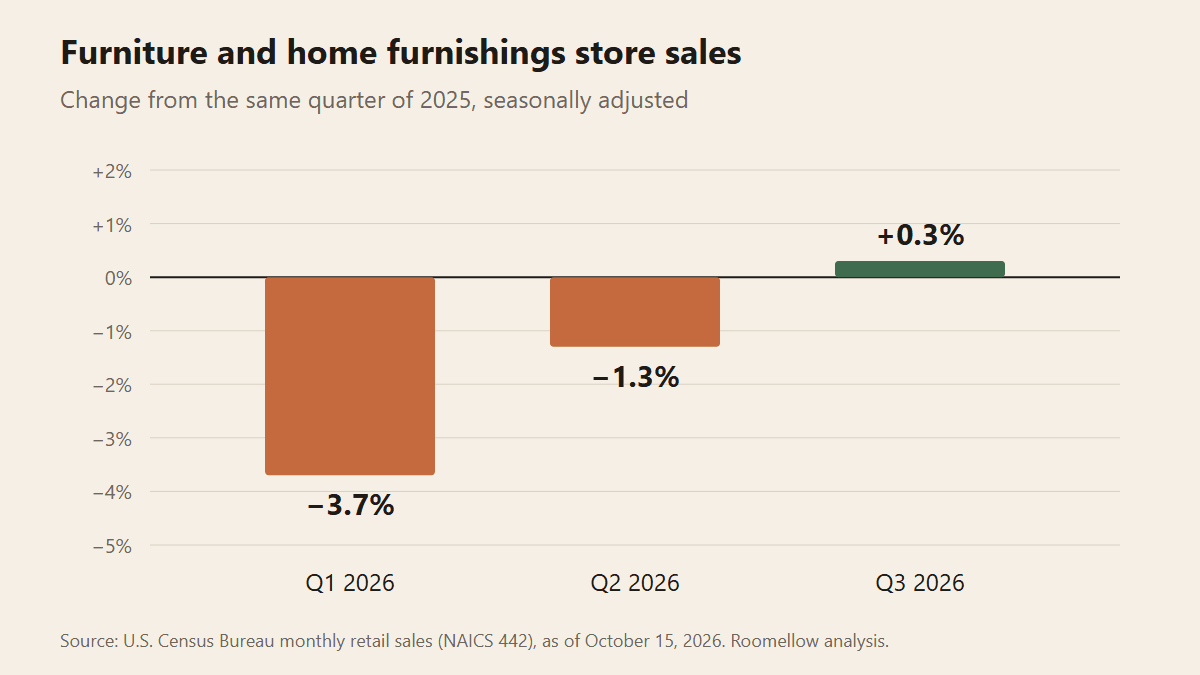
Our analysis: for each quarter, we added the three seasonally adjusted monthly figures in the Census series and compared the total with the same three months of 2025. The third-quarter result matches the +0.3% Census reports.
Furniture stores alone are still behind. The Census category combines furniture stores with home furnishings stores, such as those selling rugs, lighting and decor. Census reports furniture stores separately, with a lag and without seasonal adjustment. In August (a preliminary figure), furniture stores sold $5.60 billion, about 6% less than the $5.95 billion of August 2025. The September figure for furniture stores alone isn't out yet.
It's a first estimate. Census revises its advance figures. For this category, the median revision to the month-to-month change is half a percentage point, and the revised September number arrives on November 17.
Furniture Prices Fell While Store Sales Rose
In the September Consumer Price Index, prices overall rose 3.7% over the year, while furniture and bedding prices fell 2.4%:
| Category | Price change, Sep 2025 to Sep 2026 |
|---|---|
| All items | +3.7% |
| Furniture and bedding | −2.4% |
| Bedroom furniture | −3.7% |
| Living room, kitchen and dining room furniture | −0.7% |
| Other furniture | −5.0% |
Furniture and bedding prices fell even as furniture and home furnishings store sales increased. That suggests the sales improvement was not simply the result of higher furniture prices. However, the two measures cover different product mixes, and the price index covers every kind of seller, not only furniture stores, so together they can't tell us exactly how much more shoppers bought.
Factory Orders Are Up Too
Smith Leonard, an accounting firm in High Point, North Carolina, surveys furniture manufacturers and distributors every month. Its October 2026 Furniture Insights, covering August, found new orders up 11%, shipments up 1% and backlogs up 17% compared with August 2025. New orders were down 4% from July, and for the year so far orders are up 5% and shipments up 1%.
Rising orders and backlogs suggest the manufacturers in the survey are carrying more unfilled business than a year ago. Before you make holiday delivery promises, check lead times with your own suppliers rather than assuming the industry-wide backlog means delays for every product.
The Tariff Step on January 1
Since October 14, 2025, imports of certain upholstered wooden products, and of kitchen cabinets and vanities, have carried a 25% duty under a September 2025 proclamation. After a one-year postponement, the rates are scheduled to rise on January 1, 2027: to 30% for upholstered wooden products and 50% for kitchen cabinets and vanities. Some countries are treated differently: the proclamation caps the duty on wood products from the United Kingdom at 10%, and from the European Union and Japan at 15% including the normal duty, and other countries that reach an agreement can be treated differently too. These increases cover the specific imported products the proclamation lists, not all upholstered furniture, and the actual duty on a given product depends on its classification, its country of origin and any applicable trade arrangement. Confirm how your products are treated with your importer or customs adviser, and see step 2 below.
What to Do Before Thanksgiving Weekend
The National Retail Federation (NRF) forecasts 4.2% growth in November and December across core retail (not furniture specifically). More useful for timing: in NRF's October survey of 8,094 adults, 64% said they are likely to wait until Thanksgiving weekend to do most of their holiday shopping, and 53% plan to shop online.
So, for the next three weeks:
- Build a cautious holiday forecast. Use your own store's year-to-date performance and recent sales trend as the baseline, rather than assuming September's 4.9% growth will continue. For the category as a whole, the year so far is down 1.5%.
- Ask your upholstery suppliers, in writing, what happens on January 1. Will they raise prices, by how much, and from what order date? Only tell shoppers to "buy before prices go up" if a supplier has confirmed an increase. A deadline you can't back up costs more trust than it earns.
- Promise delivery dates you can keep. Confirm lead times with your suppliers, check which pieces are in stock or arriving before late December, and say so on the product page. Our guide to cart abandonment covers why a delivery surprise at checkout loses the sale.
- Get product pages ready before the weekend, not during it. Shoppers comparing online need the price, financing, dimensions and delivery window, all readable on a phone. They also need to picture the piece at home. Roomellow helps retailers close that gap by letting shoppers see real catalog products together in a photo of their own room, then continue shopping in the retailer's own store. The rooms are AI-generated visualizations, not a guarantee of exact scale or color, so shoppers should still check dimensions.
- Don't set every markdown at once. The October data arrives before Black Friday (see the dates below). Leave room to adjust.
What We Don't Know Yet
- Whether September holds up. The advance estimate will be revised, and furniture stores' own September figure is still to come.
- Whether prices keep falling. The January tariff step, if it happens on schedule (it has been postponed once), could push upholstery prices the other way.
- Whether factory orders turn into store sales. Shipments, and store sales next year, will show whether shoppers follow the restocking.
Dates to Watch
- November 10: October Consumer Price Index (U.S. Bureau of Labor Statistics).
- November 17: October retail sales, the revised September figure, and furniture stores' September sales (U.S. Census Bureau).
- January 1, 2027: the scheduled tariff increase on upholstered wooden products, kitchen cabinets and vanities.
Further Reading
Sources
- Advance Monthly Sales for Retail and Food Services, September 2026 (CB26-165), U.S. Census Bureau,
- Advance Retail Sales: Furniture and Home Furnishings Stores (RSFHFS), Federal Reserve Bank of St. Louis (FRED), from U.S. Census Bureau data,
- Consumer Price Index, September 2026, Table 2, U.S. Bureau of Labor Statistics,
- October 2026 Furniture Insights, Smith Leonard,
- Adjusting Imports of Timber, Lumber, and their Derivative Products into the United States, The White House,
- Amendments to Adjusting Imports of Timber, Lumber, and their Derivative Products into the United States, The White House,
- NRF Forecasts 2026 Holiday Sales Growth as Consumers Remain Resilient, National Retail Federation,
- Affordability Shapes Winter Holiday Shopping, According to NRF Holiday Survey, National Retail Federation,
See it with your own products
Shoppers upload a photo of their room, see your products in it, and buy from your store. We'll show you how it would work with your catalog.