How to Pick a Rug for Living Room: The Ultimate Guide
Struggling with how to pick a rug for your living room? This guide demystifies sizing, materials, and patterns to create a cohesive, luxurious space. Get started today!
By Roomellow Team
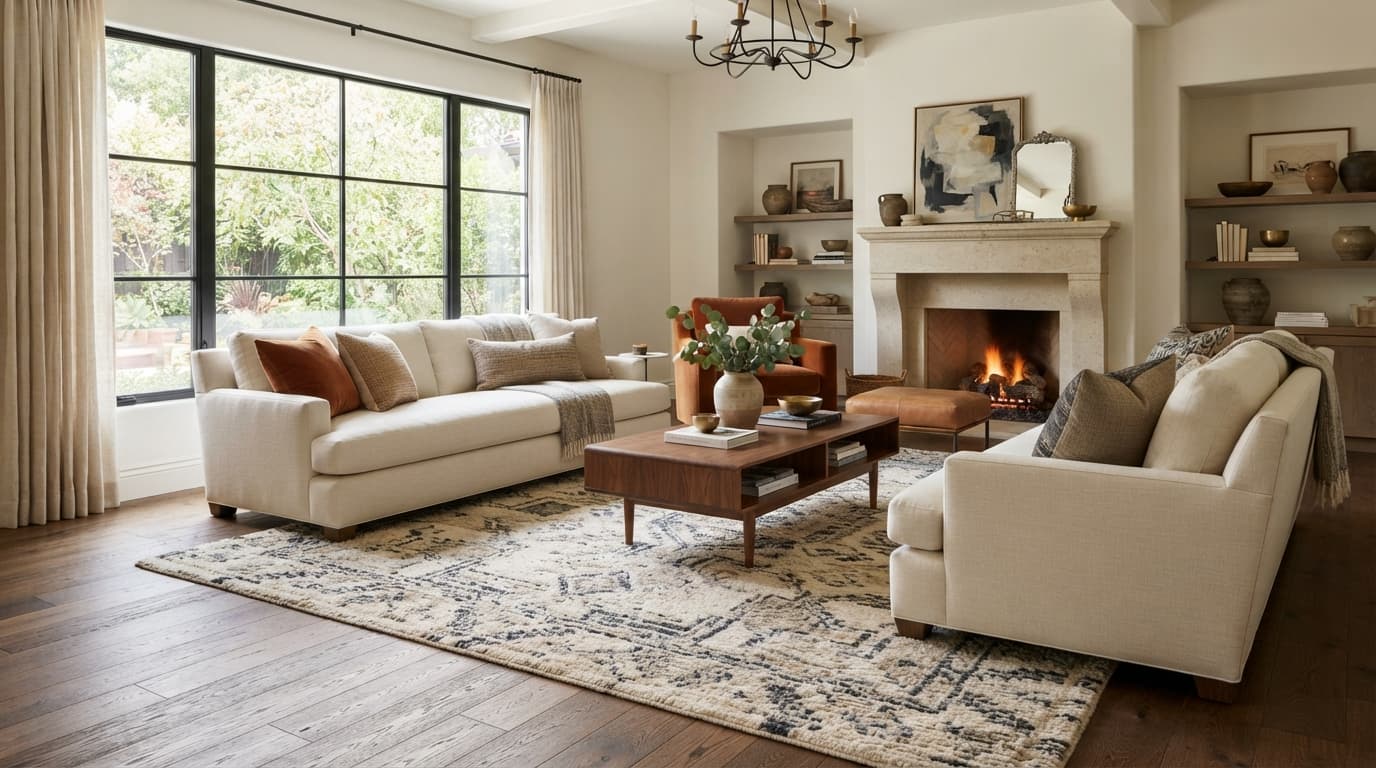
The living room rug. It’s one of those pieces that often gets overlooked, or worse, completely mishandled. I’ve seen countless rooms that feel disjointed or unfinished, and nine times out of ten, a tiny, sad rug is to blame. A rug isn't just a pretty accent; it’s the foundation of your living space. It defines the area, anchors your furniture, adds warmth, softens acoustics, and injects personality. Get it right, and your living room will feel cohesive, luxurious, and utterly intentional. Get it wrong, and you’ll forever be battling a space that feels off-kilter.
Choosing the right rug can feel overwhelming with all the sizes, materials, patterns, and colors out there. But trust me, it doesn’t have to be. I’m here to demystify the process and give you my honest, actionable advice on how to pick a rug for your living room that you’ll love for years to come.
The Golden Rule of Rug Sizing: Go Big or Go Home
This is the most critical piece of advice I can give you. Seriously. The biggest mistake people make is buying a rug that’s too small. A rug should ground your furniture, not float aimlessly in the middle of the room like a postage stamp. When you go big, you create a sense of cohesion and make the room feel larger and more intentional.
How Big, Exactly? Let's Talk Specifics
For a Standard Sofa & Two Armchairs: A 8x10 rug is usually the bare minimum here. You want at least the front two legs of your sofa and any armchairs to comfortably sit on the rug. This creates a defined seating area and makes everything feel connected. If you have a larger room or a longer sofa (think 90+ inches), an 9x12 rug is even better, allowing all legs of your main pieces to sit on it.
For a Sectional Sofa: This is where you absolutely, unequivocally need to go big. A 9x12 rug under a sectional is non-negotiable for most standard sizes. If you have a particularly large sectional or a very spacious living room, I’d push for a 10x14 or even larger if you can find it. Every single leg of your sectional should be on the rug. If not all legs can be on, then at least the front two legs of all sections of the sofa should be. Anything less, and your beautiful sectional will look like it's hovering, rather than being part of a cohesive design.
For Smaller Living Rooms or Apartments: I know, I know, "go big" is hard when your room isn't big. But the principle still applies. For smaller spaces, a 5x8 might work if you have a love seat and one accent chair, with just the front legs on the rug. However, even in a compact setting, an 8x10 often surprisingly makes the room feel larger by extending the visual boundaries of the seating area. If you're struggling with how to design a small living room, remember that visual tricks like a larger rug can really help. Don't be afraid to pull your furniture off the walls and let the rug define the floating zone.
My Honest Take on Small Rugs
They make your room look smaller, your furniture look disproportional, and they rarely serve their purpose of anchoring the space. If your rug is only barely peeking out from under a coffee table, or if it looks like a bathmat under your sofa, it's too small. Save your money and invest in the correct size. It's often better to have no rug than a rug that's too small.
The Space Around the Rug: Ideally, you want to leave about 10-24 inches of bare floor around the edges of your rug. This creates a visual border that frames the seating area beautifully and prevents the room from feeling like it’s drowning in carpet.
Material Matters: What Your Lifestyle Demands
Beyond size, the rug material will dictate its feel, durability, cleanability, and ultimately, its lifespan in your home. This is where your actual life needs to meet your aesthetic desires.
-
Wool: My personal favorite and generally the gold standard for living room rugs.
- Pros: Incredibly durable, naturally stain-resistant (thanks to lanolin), soft underfoot, excellent at sound absorption, and retains its shape well. It’s also fire-resistant and holds color beautifully. A quality wool rug will last decades.
- Cons: Can be pricey, and new wool rugs often shed quite a bit for the first few months. Some people find them slightly scratchy if it’s a rougher weave. Not ideal for severe allergies if you're sensitive to wool fibers.
- Best for: High-traffic areas, families, those looking for a long-term investment. Expect to pay anywhere from $400 for an 8x10 to $2000+ for higher quality or larger sizes.
-
Cotton: Often found in flatweave or dhurrie rugs.
- Pros: Affordable, soft, lightweight, and often reversible. Smaller cotton rugs can sometimes be machine washable.
- Cons: Less durable than wool, prone to staining, and can wear out faster in high-traffic areas.
- Best for: Lower traffic areas, layering over a larger rug, budget-conscious decorators. An 8x10 might run $100-$400.
-
Jute/Sisal/Seagrass: The go-to for natural texture and a relaxed, organic vibe.
- Pros: Sustainable, highly textured, adds an incredible grounding element to a room, hides dirt well.
- Cons: Can be rough underfoot (especially sisal), difficult to clean spills (they absorb quickly), and can fray over time. Jute can shed fine fibers.
- Best for: Coastal interior design ideas, bohemian, or farmhouse aesthetics, lower traffic areas, or as a base layer for another rug. An 8x10 is typically $200-$700.
-
Viscose/Rayon/Art Silk: The "shiny" imposters.
- Pros: Offers a beautiful sheen and incredibly soft, silky feel at a fraction of the cost of real silk. Looks luxurious.
- Cons: This is where I get really honest: they are a nightmare for spills and high traffic. Water leaves permanent stains, and fibers crush easily, showing traffic patterns. They are not durable.
- Best for: Very low-traffic areas, decorative purposes only, or in spaces where spills are absolutely not a concern. Honestly, I generally recommend avoiding them for main living spaces.
-
Synthetic (Polypropylene/Polyester/Nylon): The workhorses of the rug world.
- Pros: Very durable, highly stain-resistant, fade-resistant, and usually very affordable. Great for homes with pets and kids.
- Cons: Can feel less luxurious or soft than natural fibers. Some can look a bit shiny or "plastic-y." They don't have the same longevity as a quality wool rug.
- Best for: High-traffic living rooms, homes with children and pets, anyone on a budget. An 8x10 can range from $100 to $600.
-
Silk:
- Pros: Unrivaled softness, luxurious sheen, incredible detail in patterns.
- Cons: Extremely expensive, delicate, difficult to clean, and not suitable for high-traffic areas.
- Best for: Heirloom pieces, very formal living rooms, or as a small accent rug.
My Honest Take on Material Trade-offs
I love the look of a cozy bouclé rug – it screams warmth and texture. But if you have shedding pets or messy kids, that high-pile, looped texture is going to trap everything and be a nightmare to clean. You have to be realistic about your lifestyle. A polypropylene rug might not feel as high-end as a hand-knotted wool, but if it means you don't stress every time your dog walks across it, that's a win in my book.
Color, Pattern, and Texture: Setting the Vibe
Once you've nailed down size and material, it's time for the fun part: aesthetics.
Starting Point: Which Comes First?
My advice? If you're starting a room redesign from scratch, consider the rug early on. It's often easier to find a rug you love and then build the rest of your color scheme and furniture around it. If you already have your sofa and other major pieces, then the rug needs to complement them. Think of the rug as the fifth wall, providing an opportunity for major impact.
Color: The Foundation of Your Palette
- Neutral Base: A solid, neutral-colored rug (think ivory, cream, beige, light gray, or even a soft charcoal) is a safe and versatile choice. It allows your furniture, artwork, and accessories to be the stars and provides a calming backdrop. This is a great strategy if you like to change out your decor seasonally or want your living room color schemes and combinations to evolve over time.
- Bold Statement: Don't shy away from a rug with a strong color if that's what your heart desires! A deep emerald, a rich terracotta, or a vibrant blue can instantly inject personality and sophistication. Just make sure it harmonizes with the rest of your room. Pull a couple of colors from the rug into throw pillows or decorative objects to tie it all together.
Pattern: Adding Interest and Camouflage
- Subtle Textural Patterns: If you have patterned upholstery or lots of art, a rug with a subtle, tone-on-tone pattern or a textured weave (like a chunky loop or high-low pile) adds interest without competing.
- Geometric & Abstract: These patterns can bring a modern edge and energy. They work beautifully with solid-colored sofas and minimalist decor, like those seen in some of our modern or scandinavian designs. Make sure the scale of the pattern feels appropriate for your room size; too small a pattern can feel busy, too large can overwhelm.
- Traditional & Oriental: These intricate patterns add warmth, history, and a touch of elegance. They are surprisingly versatile and can look fantastic even in contemporary settings, adding a layer of sophisticated contrast. They’re also excellent at hiding spills and everyday wear.
Texture: The Unsung Hero
Don't underestimate the power of texture! A rug with a pronounced texture can add depth and warmth to a room even if it's a solid color. Think of a plush shag for ultimate coziness, a flatweave for a sleek, bohemian look, or a jute rug for an earthy, organic feel. Mix and match textures in your living room – a smooth leather sofa paired with a chunky knit wool rug, for example – to create a rich, inviting space.
Layering Rugs: When and How to Do It Right
Yes, you can use more than one rug! Layering rugs is a fantastic way to add extra warmth, define zones, introduce more pattern or texture, or make a too-small rug work for a larger space.
- The Base Rug: Start with a larger, typically neutral, flatweave rug (like jute, sisal, or a low-pile wool in a solid color). This acts as your foundation.
- The Top Rug: On top, place a smaller, more decorative rug. This could be a patterned wool, a sheepskin, or a vintage kilim. Make sure the top rug is considerably smaller than the base rug, leaving a generous border of the base rug visible.
- Placement: Position the top rug to anchor a specific seating arrangement or coffee table. It should not be floating in the middle.
- Safety First: Always use a non-slip rug pad under both rugs to prevent tripping and slippage.
Cost & Care: Setting Expectations
Budgeting: Rug prices vary wildly. You can find a basic 8x10 synthetic rug for under $200, or a hand-knotted wool masterpiece for thousands. Set a realistic budget based on your desired material and size. Remember, a good rug is an investment.
Rug Pads: Absolutely Essential. Never, ever skip the rug pad. I mean it. A good rug pad does several things:
- Prevents Slipping: Crucial for safety, especially with kids or pets.
- Protects Floors: Acts as a barrier between the rug and your hard flooring, preventing scratches.
- Extends Rug Life: Reduces wear and tear on the rug fibers by providing a cushion.
- Adds Comfort: Makes the rug feel more plush and luxurious underfoot.
Cleaning & Maintenance: Vacuum regularly, at least once a week, to prevent dirt and grit from settling into the fibers (which can cause premature wear). Address spills immediately with a clean cloth and appropriate cleaner. For deeper cleaning, consider professional services every 1-3 years, especially for wool rugs.
The Roomellow Way: Visualizing Your Perfect Rug
Choosing a rug is a big decision because it has such a huge impact on your living room. It's tough to really know how a rug will look and feel in your space just from an online photo or a small swatch. This is where Roomellow comes in.
You can upload a photo of your actual living room to our platform, and we’ll show you how different rugs from various furniture stores look in your space. Want to see that abstract geometric rug from one brand, or a plush shag from another? You can visualize it instantly. This takes out all the guesswork and helps you make a confident decision. If you're wondering how to visualize furniture in a room or looking for an easy way to try new designs, give Roomellow a try yourself. We're constantly adding new products to help you create your dream home, whether you're tackling a complete living room redesign or just looking for that perfect accent.
Ready to redesign your room?
Upload a photo of your room and get a professional AI redesign with real furniture you can buy. Free to try — no credit card required.
Try Roomellow free