Transform Your Home Office: The Power of an Accent Wall
Elevate your home office design! Discover how an accent wall can define your workspace, boost focus, and add style. Start planning your dream office today!
By Roomellow Team
Creating a home office that feels both inspiring and productive can sometimes feel like chasing a moving target. We all want that perfect blend of functionality and personal style, but often, the reality is a spare corner, a repurposed guest room, or even just a slice of the living room. If you’ve been staring at a blank wall, feeling like something is missing, or simply needing a way to distinguish your workspace from the rest of your home, let’s talk about the transformative power of a home office accent wall.
An accent wall isn't just about throwing a bold color onto one surface and calling it a day. For me, it's about intentional design – a strategic move to infuse personality, define a zone, and even influence your mood and focus while you work. In an office setting, it's particularly potent because it directly impacts your visual field for hours a day. It’s a chance to make a statement, to ground your desk area, and to elevate the entire feel of your workspace without undertaking a full-blown renovation.
The Strategic "Why" Behind a Home Office Accent Wall
Before we dive into the "how," let’s really unpack the "why." You might be thinking, "It's just one wall, how much of a difference can it make?" The answer is: a significant one.
Defining Your Workspace Zone
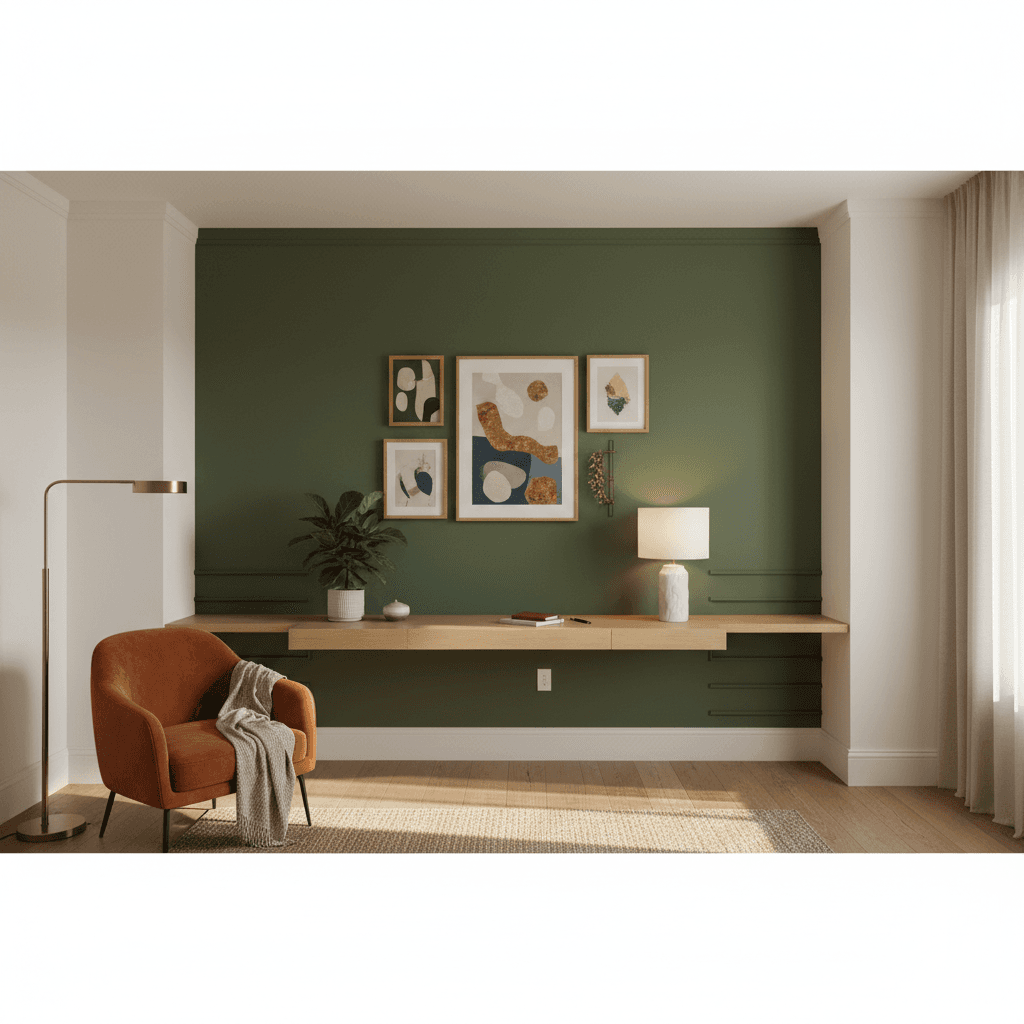
Many of us don't have the luxury of a dedicated, separate office room. Your "office" might share space with your guest bed, your living room, or even your dining area. This is where an accent wall shines. By treating one wall differently – whether with color, texture, or pattern – you visually carve out your workspace. It's a psychological cue that tells your brain, "This is where work happens," helping you transition into a more focused mindset. When I designed my own small office nook, a deep forest green accent wall immediately distinguished it from the adjacent, more neutral living space, creating a clear boundary without a physical partition.
Boosting Focus and Creativity
Monotony can be a productivity killer. A visually stimulating accent wall can act as a subtle brain-booster. A rich, calming color like a deep teal or a warm sage can create a serene backdrop for concentration. A subtle geometric pattern or a textured wall can add visual interest without being distracting, fostering a more engaging environment. For creatives, a vibrant mural or bold abstract wallpaper can spark imagination. Think about what kind of energy you want in your office and let the wall guide it.
Injecting Personality and Style
Your home office should reflect you. It’s not just a functional space; it’s a personal one. An accent wall is a perfect canvas for expressing your unique style, whether that's minimalist chic, cozy bohemian, sleek modern, or industrial edge. It gives you permission to be a little bolder than you might be in a larger, more public area of your home. It’s your chance to play with a trend you love or a color you’ve always wanted to try without committing to an entire room.
Choosing the Right Wall
This is perhaps the most crucial decision. Not every wall is created equal when it comes to being an accent.
The most common and often most effective choice is the wall behind your desk. This is usually the wall you face when working, or the wall that forms the backdrop for video calls. Painting this wall a distinctive color or adding texture here instantly grounds your desk area and makes it the focal point of the room. It also frames your workspace beautifully for virtual meetings.
Considerations for placement:
- Windows: Avoid making a window wall your accent wall. The natural light will wash out the effect, and the window itself is already a focal point.
- Built-ins or large furniture: If you have extensive shelving or a bulky credenza on one wall, that wall might already have enough visual weight. An accent wall here could make the space feel too busy or heavy.
- Entry points: An accent wall on the wall you see immediately upon entering the room can create a dramatic first impression. This works well in a dedicated office but might be overwhelming in an open-concept space.
- What's on the wall: Think about what will be on the accent wall. Will it hold open shelving? A large piece of art? A monitor? Make sure your wall treatment complements, rather than competes with, these elements. For example, a busy wallpaper might clash with a gallery wall, whereas a solid deep color could make artwork pop.
For most home offices, I lean towards the wall directly behind the desk. It provides the strongest visual impact and creates that essential defined zone.
Types of Home Office Accent Walls: Options & Opinions
Now for the fun part: what kind of accent wall are we talking about? There are so many possibilities beyond a simple coat of paint, each with its own advantages and considerations.
1. The Power of Paint
Paint is the most accessible and often most budget-friendly option. But "just paint" doesn't mean "boring."
-
Bold Solid Color: This is where most people start, and for good reason. A deep, saturated color instantly creates drama and depth.
- My Opinion: Don't shy away from darker shades. A deep navy like Benjamin Moore's Hale Navy, a rich charcoal like Sherwin-Williams Peppercorn, or an earthy green like Farrow & Ball's Bancha can create an incredibly sophisticated and calming backdrop. These colors recede, making the room feel more expansive and cocoon-like, not smaller.
- Trade-offs: If your room lacks natural light, a very dark color might feel too heavy unless balanced with ample task and ambient lighting.
- Cost: A gallon of good quality paint typically ranges from $40 to $80. You might need two coats, so plan for a gallon and a half for an average 10x10 foot wall.
- Example Pairing: Imagine a deep forest green accent wall (think Sherwin-Williams Evergreen Fog) with a light oak desk and a black metal shelving unit. The contrast is sharp and modern.
-
Two-Tone or Geometric Patterns: A simple horizontal line, half-painting a wall, or even a subtle geometric shape can add interest without overwhelming.
- My Opinion: For a home office, a half-painted wall (top half a light neutral, bottom half a deeper color) can add a sense of grounding. It's less commitment than a full wall of bold color but still creates visual separation. Geometric patterns require more precision with painter's tape but can look incredibly sharp and modern.
- Trade-offs: Geometric patterns require patience and a steady hand. Imperfections will be noticeable.
- Cost: Similar to a solid color, perhaps a little more in tape and time.
2. The Intrigue of Wallpaper
Wallpaper has made a huge comeback, and for a home office, it's a fantastic way to introduce pattern, texture, and sophisticated flair.
-
Patterned Wallpaper: From subtle botanicals to abstract geometrics, a well-chosen pattern can be a true showstopper.
- My Opinion: Choose a pattern that suits the scale of your room. In a smaller office, a large, repetitive pattern can actually make the space feel bigger because the eye travels across it easily. Conversely, a very small, busy pattern might feel overwhelming. Peel-and-stick options are a great way to experiment without permanent commitment, especially for renters or those who change their minds frequently.
- Trade-offs: Can be more expensive than paint. Installation requires more skill – consider hiring a professional for complex patterns or large walls.
- Cost: Peel-and-stick rolls can start around $30-$50 per roll (covering ~30 sq ft), while high-end traditional wallpaper can be $100-$300+ per roll. A standard 8x10 wall could need 3-5 rolls depending on pattern repeat.
- Example Pairing: A subtle abstract or botanical wallpaper from stores like Anthropologie or Wayfair paired with a sleek white or glass desk and minimalist accessories.
-
Textural Wallpaper: Grasscloth, linen-look, or even subtle embossed designs add depth and warmth without bold patterns.
- My Opinion: Grasscloth is a perennial favorite for its organic texture and ability to bring warmth to a space. It’s elegant and timeless. A linen-look wallpaper can offer a similar effect for a lower price point and easier maintenance.
- Trade-offs: Grasscloth can be delicate and easily damaged, especially if you have pets or active kids. It's also more challenging to install due to visible seams.
- Cost: Often on the higher end, $70-$200+ per roll.
3. Architectural Interest with Wood Paneling/Molding
Adding wood treatments to a wall brings dimension, structure, and a bespoke feel that paint alone can't achieve.
-
Board and Batten: A classic, timeless look that adds depth and a tailored feel. It works well in almost any style, from traditional to modern farmhouse.
- My Opinion: For an office, I love board and batten installed halfway or two-thirds up the wall, capped with a small ledge. This creates a functional display space for small artwork, plants, or books, in addition to the visual interest. Paint it a solid color (dark or light) for a unified look.
- Trade-offs: This is a more involved DIY project requiring basic carpentry skills (measuring, cutting wood, using a nail gun, caulk).
- Cost: Wood strips can be $1-$5 per linear foot, plus paint, caulk, and tools. A 10-foot wall could range from $150-$400 in materials.
-
Shiplap/Tongue & Groove: Offers a more casual, coastal, or modern farmhouse aesthetic.
- My Opinion: While popular, I’d caution against shiplap if you're aiming for a sleek, contemporary office. It can sometimes lean a bit too rustic. However, a clean, modern shiplap (wider planks, smooth finish, painted a crisp white or soft gray) can look fantastic in a bright, airy space. Tongue and groove offers a slightly softer, more refined look.
- Trade-offs: Installation requires careful alignment and potentially more cuts around outlets.
- Cost: Similar to board and batten, around $1-$7 per square foot for material, depending on wood type and finish.
-
Fluted/Reed Panel: A sophisticated, highly textural option that screams modern luxury.
- My Opinion: This is a showstopper. Whether you buy pre-made fluted panels or apply individual half-round moldings, the vertical lines create incredible visual interest and movement. Paint it a contrasting color to the surrounding walls, or match it for a subtle textural effect. It’s perfect for a minimalist or modern office.
- Trade-offs: Definitely a more advanced DIY or best left to a professional. Pre-made panels are easier but more expensive.
- Cost: Pre-made panels can be $50-$200 per 4x8 sheet. Individual molding pieces are cheaper per foot but require more labor.
4. Beyond the Norm: Other Textural Options
For those looking for something truly unique, consider these less common but equally impactful options.
-
Brick Veneer: Want to evoke a loft apartment or industrial vibe? Brick veneer panels or individual brick slices can add a raw, urban texture.
- My Opinion: This works best if your home's architecture or your overall aesthetic supports it. A single brick accent wall can be incredibly impactful, especially when paired with industrial lighting and sleek metal furniture.
- Trade-offs: Can feel heavy in a small space. Installation involves mortar or adhesive and can be messy.
- Cost: Brick veneer panels are around $5-$15 per square foot.
-
Plaster/Lime Wash: For an organic, wabi-sabi, or Mediterranean feel, a plaster or lime wash finish offers subtle movement and a sophisticated matte texture.
- My Opinion: This is my favorite for adding subtle depth and an artisanal quality. The uneven, mottled finish creates a soft, inviting atmosphere. It’s perfect for a minimalist office that still wants warmth and character.
- Trade-offs: Can be a bit tricky to apply evenly without practice. Best done by following specific instructions carefully.
- Cost: Lime wash paint kits are typically $50-$100 and cover a decent area.
Integrating Your Accent Wall with the Rest of the Office
An accent wall doesn't exist in a vacuum. Its success depends on how well it plays with the other elements in your office.
Furniture Harmony
Your desk, chair, and any shelving should complement your accent wall, not compete with it.
- Contrast is Key: A dark accent wall often looks fantastic with light-colored furniture – think a deep navy wall behind a natural oak desk or a crisp white desk chair. The contrast makes both elements stand out.
- Balance with Neutrals: If your accent wall is a bold color or busy pattern, keep the majority of your furniture in neutral tones (whites, grays, natural woods, blacks). This allows the wall to be the star without the room feeling chaotic.
- Material Play: A textured accent wall (like wood paneling or grasscloth) often pairs beautifully with smooth, sleek materials like metal, glass, or polished stone in your desk or accessories.
Remember, your desk is the anchor. Consider its material and color when choosing your accent wall. A dark walnut desk will have a very different presence against a pale blue wall than it will against a vibrant yellow one. For more ideas on creating a productive space, check out our home office setup ideas for productivity.
Thoughtful Decor & Accessories
Less is often more when you have a strong accent wall.
- Artwork: If your accent wall is a solid color, it's a perfect backdrop for artwork. Choose pieces with frames that pop against the wall – a gold frame on a deep green wall, for instance. For a patterned wall, be more selective; a single, large piece or a simple mirror might be enough. Avoid busy gallery walls on highly patterned accent walls.
- Shelving: Floating shelves can look sleek against an accent wall. If your wall is dark, opt for light-colored shelves (white, blonde wood) to create contrast and keep the space feeling open. Don't overload the shelves; a few curated items are more impactful.
- Lighting: Consider how lighting interacts with your accent wall. A picture light over a large piece of art or a well-placed sconce can highlight the wall's texture or color beautifully. Task lighting on your desk should be functional but also aesthetically pleasing.
The Bigger Picture
Think about how the accent wall fits into the overall aesthetic of your home. While it’s good to be bold in an office, you don’t want it to feel completely disconnected from the rest of your living space, especially in open-concept homes. Consider pulling a secondary color from your living room into your office accent wall, or using similar textures. This creates a cohesive flow throughout your home.
Common Mistakes to Sidestep
Even with the best intentions, it's easy to make a misstep that diminishes the impact of your accent wall.
- Choosing the Wrong Wall: As discussed, don't pick a wall with too many windows, doors, or existing visual clutter. The goal is to highlight, not to compete.
- Over-Accessorizing: Once you have a striking accent wall, let it breathe. Don't fill it with too many small pieces of art, busy shelves, or overly decorative elements. The wall itself is the design statement.
- Ignoring Scale and Proportion: A tiny print on a huge wall will get lost. A massive, busy pattern in a very small room can feel overwhelming. Consider the size of your room and the scale of your chosen pattern or texture.
- Forgetting Functionality: It's still an office! Make sure your accent wall choice doesn't interfere with essentials like mounting monitors, installing shelving, or managing cables. For example, a deeply textured wall might make it harder to flush-mount a monitor.
- Lack of Cohesion: Your accent wall should feel like an integrated part of your office, not an afterthought. Ensure the colors, textures, and overall style connect with your desk, chair, and other decor.
Visualizing Your Perfect Home Office Accent Wall with Roomellow
Deciding on the perfect accent wall can be tough, especially when you're trying to imagine how a deep green paint or a bold patterned wallpaper will actually look in your unique space. That's where Roomellow can be a real game-changer. You can simply upload a photo of your existing home office, and our AI will generate redesigns, letting you experiment with different accent wall ideas – from various paint colors and wallpaper patterns to wood paneling – and see them in context with real, purchasable furniture from many different furniture stores. It’s an invaluable tool for visualizing these changes before you commit to paint or materials. You can even try it yourself to see what a new desk and a vibrant accent wall could do for your productivity and mood! If you're looking for more ways to transform your space, check out our guide on how to redesign your room with AI.
Ready to redesign your room?
Upload a photo of your room and get a professional AI redesign with real furniture you can buy. Free to try — no credit card required.
Try Roomellow freeAn accent wall in your home office is much more than a decorative flourish. It’s a purposeful design decision that can create definition, stimulate creativity, and infuse your workspace with personality. By carefully considering the type of wall, the material, and how it integrates with the rest of your office, you can craft a space that not only looks fantastic but truly supports your work and well-being.