How to Brighten a Dark Room: 9 Fixes That Actually Work
How to brighten a dark room without new windows: warm whites, a mirror in the right spot, sheer curtains, layered lighting, lighter furniture and low-light plants.
By Roomellow Team
There's nothing quite like walking into a bright, airy room. But not every room gets south-facing windows. Maybe your apartment has one small window, or your living room faces north and sits in dim light most of the day. It's one of the most common design problems we see, and it can make a space feel cramped, uninviting or a little gloomy.
The good news: you can brighten a dark room without knocking down walls or adding windows. More lamps help (we'll get to lighting), but the bigger wins come from how your colors, surfaces and furniture handle the light you already have. Here are the nine changes we'd make, with the trade-offs of each.
1. Paint with Purpose: It's More Than Just White
When people think "bright room," they usually jump straight to pure white paint. White does reflect light, but in a room starved of daylight, a stark, cool white can fall flat and feel cold, even clinical.
Our take: Instead of the brightest white on the chart, choose light-reflecting colors with a little warmth or softness.
- Warm whites: These are our go-to. Colors like Benjamin Moore White Dove or Sherwin-Williams Alabaster have just enough yellow or beige undertone to feel creamy and inviting in low light. They reflect light well without feeling sterile.
- Pale neutrals: Very light warm grays or greiges add a little more depth than white while keeping things airy. If you love a deeper greige such as Benjamin Moore Revere Pewter, ask the paint store to mix it at half strength.
- Soft pastels: If you want a hint of color, a very pale blush, sky blue or mint still has a high light reflectance value (LRV) and adds a gentle wash of color that can be surprisingly uplifting.
The "why": Lighter hues absorb less light and bounce more of it back into the room. They also soften the edges of the walls, which makes the room feel larger than it is.
A critical detail: Don't forget the ceiling. Painting it a shade lighter than the walls, or the same warm white, creates an unbroken flow that makes the room feel taller and more open. We rarely recommend a stark white ceiling over warm walls; in a small or dark room, matching the ceiling to a warm white wall color usually looks best.
Trade-off: Light walls, especially in a matte finish, show scuffs more easily. An eggshell or satin finish is more durable and adds a slight light-reflecting sheen, or look for a washable matte paint.
2. Master the Art of Mirror Placement
Mirrors are your best friend in a dark room. Their power is in bouncing light around and creating the illusion of more space, but placement is everything.
Our take: Don't hang a mirror just anywhere. Be strategic.
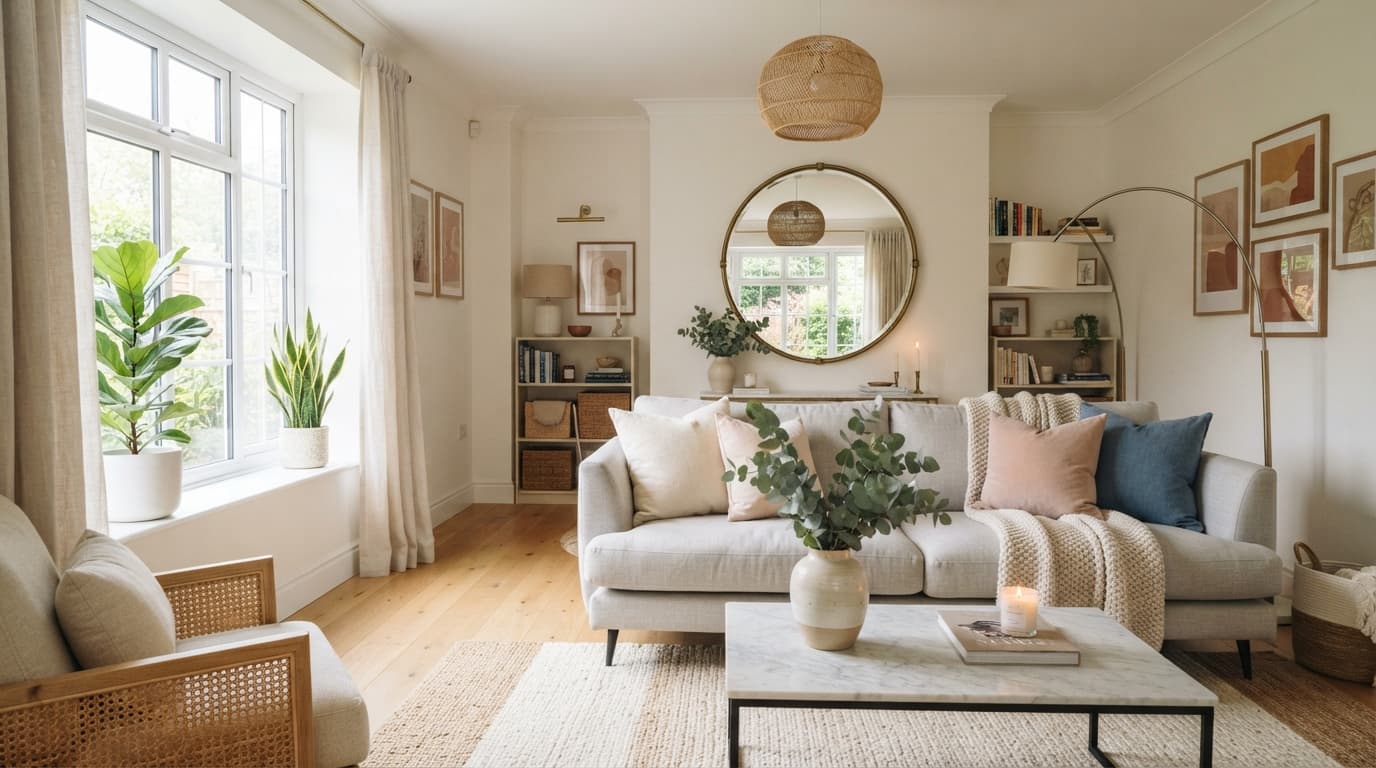
- Opposite a window: This is the golden rule. A large mirror directly across from a window reflects the outdoor view and roughly doubles the daylight you see. It works like a second window.
- To reflect a light source: If you don't have a good window view to reflect, position the mirror to bounce light from a lamp, a sconce or an overhead fixture.
- Size matters: The bigger the mirror, the bigger the effect. A floor-length mirror (48"x72" or larger) leaning against a wall can transform a room. On a gallery wall, mix in a few smaller mirrors with interesting frames.
The "why": Mirrors reflect depth as well as light. By mirroring a window or an open doorway, they trick the eye into reading more space beyond the wall.
Pro tip: Choose mirrors with thin, light or metallic frames so the focus stays on the reflection. Heavy, dark frames visually weigh the wall down.
Trade-off: A mirror that reflects clutter or an unattractive view amplifies the problem, so check what it's showing you. Too many mirrors, or mirrors in awkward spots, can also make a room feel disorienting.
3. Light-Filtering Window Treatments: Let the Light In
This sounds obvious, but it's often overlooked. Heavy drapes chosen for privacy or insulation work against you in a dark room.
Our take: Unless you truly need blackout or full privacy, swap heavy, dark drapes for something lighter.
- Sheers: Sheer or semi-sheer linen or cotton curtains in a light color (white, off-white, light gray) let daylight through and soften it without blocking it. They still give a little privacy.
- Mount high and wide: Hang the rod 6 to 12 inches above the window frame and extend it 6 to 12 inches past the frame on each side. The window looks taller and wider, and open curtains no longer cover any glass.
- Light Roman shades: If curtains aren't your style, light-filtering Roman shades in a pale fabric give a clean, tailored look and stack neatly above the glass.
The "why": Heavy, dark fabrics absorb light and make the room feel smaller. Light-filtering treatments use every bit of daylight while adding texture and softness.
Cost: Sheer panels are one of the least expensive changes on this list.
Trade-off: Sheers offer limited privacy at night. If that matters, layer them with blackout blinds, or with opaque curtains that pull fully clear of the window during the day.
4. Thoughtful Furniture Choices: Weight, Color and Material
The furniture you choose has a huge effect on how bright a room feels. Bulky, dark pieces act like black holes, soaking up light and making the space feel heavy.
Our take: Think "light" in every sense: visually and physically.
- Color palette: Choose lighter colors for sofas, chairs and larger pieces.
- Upholstery: Cream, light gray, soft blue, pale green or white upholstery reflects light instead of absorbing it. A light sectional alone can lift a whole room.
- Wood tones: Lighter woods like white oak, ash, maple or birch help. If you prefer darker wood, balance it with exposed legs and lighter upholstery.
- Material mix: Add materials that reflect light or let it pass through.
- Glass and acrylic: A glass coffee table or acrylic accent chairs almost disappear, so the room feels less cluttered and light passes through.
- Polished metals: Brass, chrome or polished nickel on table bases, lamps and accents bounce light around.
- Visual weight: Avoid heavy, solid pieces that sit flat on the floor. Furniture on exposed legs lets light flow underneath, which makes the room feel more open. A wall-mounted media console beats a chunky floor-standing one.
The "why": Light colors and reflective materials make furniture feel less imposing. When light passes through or bounces off a piece, it doesn't stop the eye, and the whole room reads brighter. It's also the main reason to think carefully when you choose furniture colors.
Trade-off: Light fabrics (especially white or cream bouclé) show dirt, pet hair and spills. With kids or pets, look for performance fabrics or washable slipcovers. Bouclé looks incredible, but it's a nightmare with pets or a glass of red wine.
5. Layered Lighting: Beyond the Single Overhead Fixture
This is where many dark rooms go wrong: one harsh overhead light, or a single lamp in the corner. A dark room needs light spread evenly and at different heights, the way daylight would be.
Our take: Plan your lighting in three layers: ambient, task and accent. A bright, inviting room needs all three.
- Ambient lighting: The general, overall light. If you have an overhead fixture, put it on a dimmer. Flush or semi-flush mounts with several bulbs spread light broadly.
- Task lighting: Focused light for specific activities: a floor lamp beside a reading chair, table lamps on side tables, or sconces on either side of a sofa. We suggest at least three or four light sources in any living room, even a small one. It's about spreading light, not just adding wattage.
- Accent lighting: Light for artwork, plants or architectural details: picture lights, small uplights behind a tall plant, or strip lights in a bookcase. These add depth and keep the room from feeling flat.
Bulb temperature is key: Avoid harsh, blue-white light (4000K and up) in a dark living space; it makes the room feel cold. Warmer bulbs (2700K to 3000K) give a soft glow closer to incandescent light, which keeps a dark room feeling cozy rather than gloomy. Dimmers on the ambient layer let you adjust the mood.
Cost: Lamps come at every price point, and two or three modest lamps placed well usually do more than one expensive fixture.
6. Strategic Use of Rugs and Textiles
Rugs, throws and pillows aren't just decoration. They're working tools for brightening a room.
Our take: Use light-colored rugs and textiles to anchor the space and bounce light upward.
- Light-colored rugs: A large rug in cream, ivory, light gray or a muted pastel brightens a room immediately, especially over dark flooring. In a living room, choose one big enough to reach under at least the front legs of the sofa and chairs, often 8x10 or 9x12. A small rug floating in the middle makes the room feel disconnected. We cover sizing in detail in how to pick a rug for a living room.
- Textiles: Light throws over a sofa and pillows in pale colors break up darker upholstery and add soft, reflective surfaces. Linen, cotton and light wool blends all work.
The "why": A large light rug acts like a reflector on the floor, bouncing light back up into the room.
Trade-off: Like light upholstery, light rugs show dirt and stains. Look for performance rugs that clean easily, or a pattern on a light base that hides small marks.
7. Embrace Metallics and Reflective Decor
Don't underestimate small, shiny objects. A few well-placed metallic accents bounce light around the room and add sparkle without taking over.
Our take: A little goes a long way.
- Brass, chrome and silver: Brass vases, silver bowls, polished chrome frames or mercury glass all catch the light. Even the hardware on furniture and light fixtures helps.
- Placement: Put them on coffee tables, shelves, side tables or a mantel, where they can catch and reflect light.
The "why": These surfaces act like tiny mirrors, picking up and scattering the light in the room.
Trade-off: Too many shiny objects can feel cluttered or gaudy. Choose a few good pieces and spread them around the room instead of clustering them.
8. Declutter Ruthlessly
This is the cheapest, fastest and often most effective way to brighten a dark room. Clutter absorbs light, casts shadows and makes a space feel smaller and more chaotic.
Our take: If you only do one thing, start here.
- Clear surfaces: Take everything you don't need off coffee tables, side tables and shelves. Every item should earn its place.
- Hide storage: Baskets, closed cabinets and storage ottomans keep everyday things out of sight.
- Leave empty space: An empty corner or a clear wall gives the eye a rest and makes the room feel lighter.
The "why": A clear room lets light travel further and bounce off surfaces without interruption. No amount of white paint can do that on its own. Clutter is also one of the most common room design mistakes to avoid.
9. Bring in Greenery, Chosen for Low Light
Plants add life, color and freshness, but a dark room needs the right ones.
Our take: Choose plants that tolerate low light, and keep them out of the window's way.
- Low-light plants: Snake plant, ZZ plant, cast iron plant and green pothos all cope well with dim rooms.
- Variegated plants need more light, not less: Their pale patterns look brighter, but with less chlorophyll they need a spot close to the window, or they fade back to plain green.
- Light-colored pots: White, cream, light gray or pale terra cotta pots add to the bright effect.
- Placement: Keep large, bushy plants away from the window so they don't block daylight. Smaller plants on shelves and side tables add life without casting shade.
The "why": Greenery adds a natural vibrancy that makes a dark room feel less oppressive and more alive.
Trade-off: Even low-light plants struggle in a room with almost no daylight. Too many large plants can also make a small dark room feel crowded.
See It in Your Own Room First
The hard part of brightening a dark room is predicting how a change will look in your light. A cream sofa that glows in a showroom can look flat in a north-facing room, and a rug that seems pale online can read darker on your floor.
With Roomellow, you upload a photo of your room and our AI redesigns it with real furniture and decor from furniture stores, so you can see lighter pieces in your actual space before you buy anything. Pick an airy style like Scandinavian or minimalist to see how much brighter the room feels with a lighter sofa, a pale rug and a few more lamps. It won't repaint your walls, but it shows how much the furniture alone can change the room.
Upload a photo of your room and see the difference before you spend a thing.
Ready to redesign your room?
Upload a photo of your room and get a professional AI redesign with real furniture you can buy. Free to try — no credit card required.
Try Roomellow free