How to Decorate an Entryway: 10 Steps for Any Size
How to decorate an entryway: measure first, choose a console or bench, hang the right mirror, layer the lighting, pick a rug the door clears, hide clutter.
By Roomellow Team
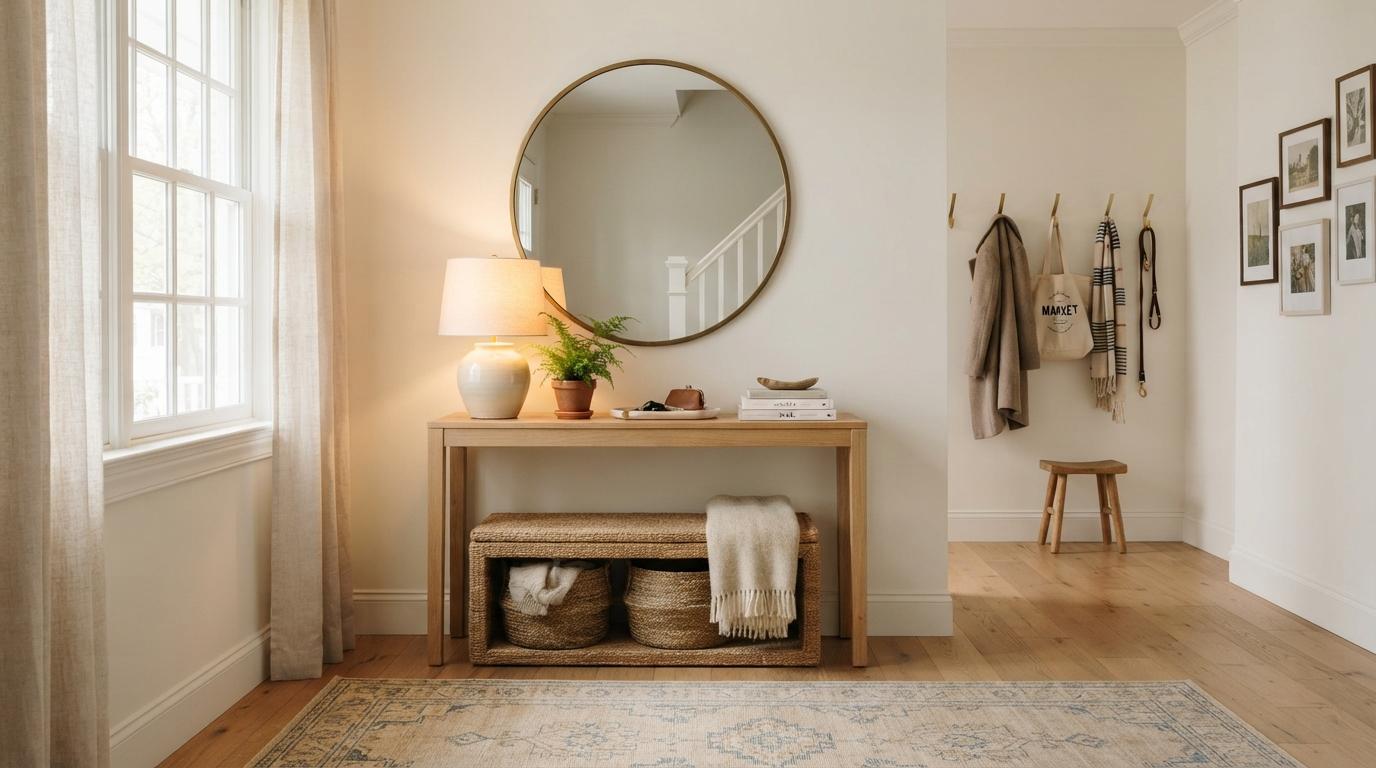
Your entryway is the first room guests see and the last one you pass on your way out. It also does more work than almost any other space in the house: keys, bags, mail, shoes, coats and the dog's leash all land there, usually in a few square feet next to the door.
That's why the best entryways are planned in a particular order: what the space has to do first, then the furniture, then the light, and only then the decorating. Here are the ten steps we'd follow, whether you have a grand foyer or a strip of wall by the front door.
1. Decide What Your Entryway Has to Do
Before you shop, spend a few days noticing what actually happens by your door. Where do the shoes pile up? Where do keys and mail end up? Does anyone need to sit down to take boots off?
Write down the jobs, in order of importance. A family with kids might need shoe storage and a row of low hooks above everything else. Someone living alone in an apartment might only need a place for keys, a mirror and a lamp.
Our take: Every entryway needs three things: a landing spot (a surface for keys and mail), a way to deal with coats and shoes, and good light. Everything else is a bonus.
2. Measure Before You Buy Anything
Most entryway mistakes are size mistakes, so measure three things:
- The door swing. Open the front door all the way and note where it stops. Nothing should sit in that arc.
- The walkway. Aim to keep a clear path about 36 inches (91 cm) wide through the space, the width most designers treat as the minimum for a main walkway.
- The wall you'll furnish. Measure its length and how far furniture can stick out from it without crowding that path.
In a narrow hallway, that last number is often only 10 to 14 inches, which rules out many standard console tables (they usually run 12 to 18 inches deep).
3. Choose Your Anchor: Console Table, Bench or Both
The anchor is the one piece the rest of the entryway is built around.
- A console table gives you a landing spot for keys, a lamp and a tray, plus room for baskets underneath. Most stand 28 to 32 inches tall. For tight halls, look for slim consoles 10 to 14 inches deep, or a wall-mounted shelf that leaves the floor clear.
- A bench gives you a place to sit while you put shoes on, and storage underneath for shoes or baskets. A seat height around 18 inches, the same as a dining chair, is comfortable for most people. Storage benches with a lift-up seat or cubbies do double duty; see our guide to multifunctional furniture for small spaces.
- Both, if you have the wall space: a console on one wall and a bench on the other, or a bench tucked under a wall of hooks.
- A round table, if you have a large foyer with space to walk around it. A round pedestal table in the middle of the room, topped with a vase or a stack of books, works better there than a console pushed against the wall.
Trade-off: A console looks more finished; a bench works harder. If you can only fit one and you take shoes off at the door, choose the bench.
4. Hang a Mirror (in the Right Spot)
A mirror is the most useful thing you can hang in an entryway. It gives you a last look before you leave, bounces light around a space that often has no window, and makes a narrow hall feel wider.
- Size: Over a console, choose a mirror roughly two-thirds to three-quarters the width of the table, so the table still frames it.
- Height: Leave about 6 to 10 inches between the tabletop and the bottom of the mirror. On a bare wall, hang it so its center sits around 57 to 60 inches from the floor, the height galleries use for art.
- Placement: Ideally, put it where it reflects a window or a light rather than the front door.
- Hanging: Entryway mirrors are often heavy. Screw into a wall stud or use anchors rated for the mirror's weight.
5. Layer the Lighting
Entryways are often the darkest spot in the house, and a single ceiling light makes them feel like a hallway in an office. Use at least two light sources:
- Overhead: A flush mount in a low hallway, or a pendant or chandelier in a taller foyer. A common rule of thumb for sizing: add the room's length and width in feet, and use that number in inches as the fixture's diameter (a 10 by 12 foot foyer suits a fixture about 22 inches across). In a foyer, hang it so the bottom sits at least 7 feet above the floor, and make sure the ceiling box is rated for a heavy fixture's weight.
- A table lamp on the console: This is what makes an entryway feel welcoming at night. Put it on a smart plug or timer so it's on when you come home after dark.
- Wall sconces: A good choice where there's no surface for a lamp, such as either side of a mirror.
Choose warm white bulbs (2700K to 3000K) for a softer, more welcoming light. For more ways to fight a dim hallway, see how to brighten a dark room.
6. Pick a Rug That Works Hard (and Clears the Door)
An entryway rug takes more dirt and foot traffic than any other rug in the house, so choose it for durability first:
- Material: Flatweave wool, indoor-outdoor polypropylene, or a machine-washable rug all handle wet shoes and grit well.
- Thickness: Check the gap under your front door before you buy. A flatweave or low-pile rug with a thin pad is the safe choice; a plush rug that catches the door will drive you mad within a week.
- Grip: Use a non-slip rug pad. Entryway rugs get stepped on at speed, often in wet shoes.
- Size: In a hallway, a runner should leave about 4 to 6 inches of floor showing on each side and stop about 6 to 12 inches short of each end.
For help with pattern and color, our guide on how to pick a rug applies to entryways too.
7. Give Clutter a Place to Hide
An entryway only looks good if the everyday stuff has a home. A few things make the biggest difference:
- Hooks: Hang coat hooks around 5 to 5.5 feet from the floor for adults, and add a lower row at 3 to 4 feet if you have kids. If anyone in your home uses a wheelchair, keep at least one hook within about 48 inches of the floor.
- A catch-all: A tray or bowl on the console for keys, sunglasses and earbuds keeps the surface from turning into a pile.
- Baskets: Lidded or woven baskets under a bench or console hide shoes, scarves and dog leashes.
- Closed storage for small spaces: Slim tip-out shoe cabinets, often under 10 inches deep, hold a surprising number of shoes and fit where nothing else will. Anchor one to the wall: tip-out cabinets are top-heavy when open, and the US Consumer Product Safety Commission advises anchoring any furniture with drawers, doors or shelves to prevent tip-overs.
- Mail: A wall-mounted organizer or a single tray keeps letters off every other surface.
Our take: Keep about a third of the console top clear. A surface that's already full has no room for the keys you're holding.
8. Add the Personal Touches
Once the practical pieces are in place, decorate:
- Art: A single larger piece usually looks better than several small ones in a tight space.
- Something living: A plant or fresh stems in a vase. In an entryway with little daylight, choose plants that tolerate low light, such as a ZZ plant, a snake plant or a pothos. All three can make cats and dogs sick if chewed, so keep them out of reach of pets. A windowless entry needs a grow bulb or a good faux plant instead.
- A layer of texture: A ceramic lamp base, a wooden bowl, a woven basket. Mixing two or three materials stops a small space from feeling flat.
Resist the urge to fill every surface. In a space you pass through every day, a few good pieces read better than many small ones.
9. Let It Preview the Rest of Your Home
The entryway sets expectations for the rooms beyond it, so borrow their colors and materials. A few starting points:
- Scandinavian: A light oak bench, white walls, a round mirror, a wool rug and a linen or paper lamp shade.
- Farmhouse: A wood console, black iron hooks, woven baskets and a vintage-style runner.
- Modern: A slim console in metal or lacquer, a thin-framed or frameless mirror and a sculptural lamp.
- Minimalist: A floating shelf, one piece of art, closed storage and nothing on the floor that doesn't need to be there.
If your rooms mix styles, our guide to mixing and matching furniture shows how to tie them together.
10. No Entryway? Make One
In many apartments and open-plan homes, the front door opens straight into the living room. You can still create an entry zone:
- Mark it with a rug. A small rug or runner by the door defines the space and catches dirt before it reaches the rest of the room.
- Go vertical. Hooks, a wall-mounted shelf and a mirror take up almost no floor space.
- Use the back of the sofa. If the sofa faces away from the door, a slim console behind it becomes your landing spot.
- Add a divider. A low open bookcase (anchored to the wall or floor if you have kids) or a tall plant can separate the entry from the living area without blocking light.
For more on making tight spaces work, see how to make a small room look bigger and our studio apartment ideas.
Getting Ready for Holiday Guests
If you're hosting this season, a few quick additions make the entryway easier for everyone:
- Extra hooks or a coat rack, so guests' coats don't end up on your bed.
- A boot tray for wet shoes, and a bench or chair so people can sit to take them off.
- A lamp on a timer, so the entry is lit when guests arrive after dark.
- One festive layer, such as a wreath on the door, a garland along the console or a vase of winter branches. Our guide to moving from fall decor to Christmas has more ideas, and if dinner is at your place, see our holiday dining room ideas.
See It in Your Own Entryway First
The hard part of decorating an entryway is picturing how the pieces fit together in such a small space: whether a console will feel too heavy, which mirror suits it, and whether a runner will tie it together or crowd it.
With Roomellow, you upload a photo of your entryway, choose Entryway as the room type and pick a style. Our AI redesigns it with real pieces from furniture stores, such as a console table or bench, a mirror, a rug, a lamp and a few accents, and every piece links to the store that sells it. Under "Where to shop", you can choose your area to see pieces from stores with showrooms nearby plus stores that ship nationwide, or pick "Ships nationwide" if there's no showroom near you. Sizes in the image are approximate, so check each product's dimensions against your measurements before you buy.
Upload a photo of your entryway and see how it could look before you buy anything.
Ready to redesign your room?
Upload a photo of your room and get a professional AI redesign with real furniture you can buy. Free to try. No credit card required.
Try Roomellow free