The Best Spot for Your Christmas Tree in the Living Room Revealed
Struggling where to put your Christmas tree in the living room? Discover expert tips for ideal placement, balancing space, flow, and holiday magic. Find your perfect spot!
By Roomellow Team
There's a particular kind of magic that washes over a home when the holiday season rolls around. The scent of pine, the twinkle of lights, the promise of cozy evenings – it all begins with the Christmas tree. But before you can drape those heirloom ornaments or string the lights, there’s the big question: "Where in the world do I put this thing?"
We've seen every version of this, from grand 12-foot spruces that look like they belong in a department store window, to charming tabletop trees that perfectly capture the festive spirit without overwhelming a compact space. The truth is, there's no single perfect spot for a Christmas tree. It's all about understanding your living room's unique layout, your personal style, and what you want the tree to do for your space.
You're not just finding a place for a decoration; you're designating a temporary focal point, a beacon of holiday cheer. And doing that well means thinking about flow, balance, and practicality. So, let's talk through the best strategies for finding that ideal spot, no matter your living room's size or setup.
The Classic Corner: A Dependable Choice
When in doubt, the corner is your friend. It's the most common placement for a reason: it's efficient, it defines the tree's presence without demanding too much attention, and it generally keeps it out of the main thoroughfare.
Why it works:
- Space-saving: Corners are often underutilized spaces. Tucking your tree here maximizes usable floor area in the rest of the room.
- Visual anchor: A corner provides two walls for the tree to lean into, making it feel stable and integrated into the room's architecture.
- Focal point, but not the focal point: The tree becomes a strong decorative element without necessarily competing with your fireplace or a large piece of art.
Our take: This placement works for most standard living rooms, especially if you have a traditional sofa and accent chairs layout. A good rule of thumb is to keep at least 12-18 inches of clearance from the wall to the outermost branches to allow for proper fluffing and decoration, especially if you're working with an 8-foot tree that might have a 50-inch base. Don't push it right up against the drywall – it looks cramped and can damage your wall finish.
Considerations:
- Outlets: Is there an outlet nearby? If not, you'll need to carefully manage extension cords and consider how to disguise them.
- Furniture rearrangement: You might need to shift a side table, a floor lamp, or even pull your sofa forward a few inches. This is where visualizing the changes beforehand can be a game-changer. Try Roomellow to see how a 7.5-foot tree would sit next to your existing sofa before you even unbox it.
The Window View: Sparkle and Scenery
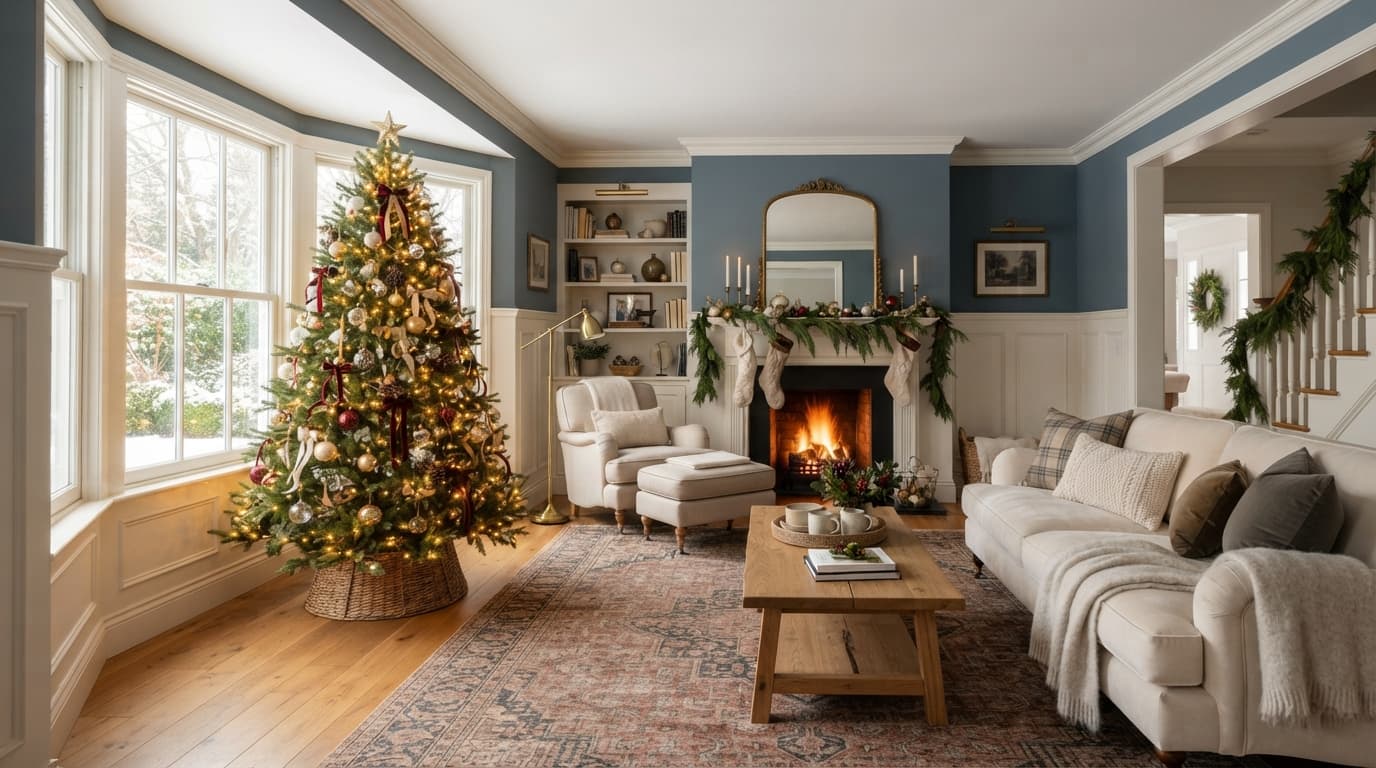
Placing your Christmas tree in front of a window is one of the most magical choices you can make. It transforms your home into a festive beacon for everyone passing by, and from inside, the natural light makes every ornament sparkle differently.
Why it works:
- Exterior impact: Your tree becomes a beautiful display for the neighborhood, spreading holiday cheer outwards.
- Enhanced sparkle: Sunlight during the day and moonlight at night can create stunning reflections off ornaments, giving your tree a dynamic quality.
- Natural backdrop: The view outside, even if it's just snow falling, adds another layer of charm to your holiday display.
Our take: While the natural light making ornaments sparkle is undeniably magical, you need to consider a few things. Is this window a primary source of light you rely on? Will the tree block a beautiful outdoor view you cherish? And critically, are your curtains or blinds going to be crushed or rendered unusable for the season? We'd steer away from this if the window is directly above a heating vent, as the heat can dry out a real tree faster and potentially damage delicate ornaments.
Considerations:
- Window treatments: You might need to temporarily remove or adjust curtains or blinds. Sheer curtains work well here or simply tying back heavier drapes for the season.
- Tree size: Don't let a huge tree completely engulf your window. Aim for a height that leaves a bit of space above the top, especially if you have a standard 8-foot ceiling. A 7-foot slim tree, typically 40-45 inches wide at the base, can look intentional and graceful, rather than cramped, in front of a window.
- Blocking light: If your living room is already on the darker side, evaluate how much natural light the tree will block. You might need to compensate with additional lamps or string lights elsewhere in the room.
The Statement Wall: Go Big or Go Home
If you have an open, uncluttered wall in your living room, particularly one that acts as a natural focal point, this is your opportunity to make the Christmas tree the undeniable star of the show.
Why it works:
- Grand statement: This placement allows a larger, fuller tree to command attention and truly define the room's holiday atmosphere.
- Uninterrupted view: Unlike a corner or window placement, an open wall allows for a 360-degree viewing experience (or at least a very wide arc), showcasing all your carefully placed ornaments.
- Design flexibility: You can easily build out a vignette around the tree, adding a cozy coffee table with holiday books, a plush throw, or decorative presents.
Our take: This is the best spot for a showstopper tree, especially in a spacious modern living room. If you have 10-foot ceilings or higher, a 9-foot tree (like a full-bodied Noble Fir, which can easily be 60-70" wide) against an open wall looks absolutely breathtaking. The key here is balance. If your tree is going to be this dominant, make sure the rest of your holiday decor complements it rather than competes with it. Think about the scale of your existing furniture – a massive tree next to a tiny accent console might look off-kilter.
Considerations:
- Traffic flow: This is critical. Ensure the tree doesn't impede pathways to other rooms, the kitchen, or your sofa. If you have to squeeze past it, it's in the wrong place. For an open concept living room, you'll need to be extra mindful of how the tree creates or disrupts zones.
- Room size: A huge tree in the middle of a small living room can feel overwhelming and make the space appear even smaller. If you're working with a compact area, explore our tips on how to design a small living room.
- Existing art/decor: You'll likely need to temporarily move artwork or smaller console tables that usually occupy that wall. Think of it as a blank canvas for your holiday masterpiece.
The Small Living Room Solution: Get Creative
Don't have a sprawling living room? No problem. Small spaces require a bit more intentionality, but you can absolutely have a beautiful, festive tree without feeling cramped.
Our take: This is where understanding dimensions truly pays off. Forget the idea that you must have a full-sized tree. A beautifully decorated 4-foot tabletop tree on a sturdy side table or a slim pencil tree can have just as much impact. Slim pencil trees at 6 or 7 feet are the sleeper pick here — their bases run far narrower than a traditional tree of the same height, which is what makes them work in a room that's already full.
Smart placement ideas for smaller spaces:
- Between two windows: If you have a narrow wall section between windows, a slim tree can fit perfectly, using vertical space without much depth.
- Behind a sofa: If your sofa isn't pushed directly against a wall, a slim tree can sometimes be placed behind it, peeking over the top. This works best with lower-profile sofas and taller, slender trees.
- On a console table: For truly tiny rooms, a 2-3 foot tree placed on a substantial console table (perhaps in an unused entryway or corner) can create a lovely festive moment without sacrificing precious floor space. Pair it with some fall home decor ideas or winter greenery for a cohesive look.
- The "half tree": Yes, these exist. Flat on one side, designed to sit flush against a wall, taking up significantly less floor space. Worth a look if you're genuinely tight on room.
Things to avoid in a small living room:
- Blocking walkways: This is non-negotiable. Don't make your everyday movements a challenge.
- Overwhelming the room: A tree that's too wide or too tall for the room's proportions will make the space feel even smaller and cluttered.
- Compromising essential seating: You don't want to remove a necessary armchair just to fit a tree. Prioritize functionality.
Critical Considerations Before You Decide
Regardless of where you're leaning, these practical points will ensure your holiday season is filled with joy, not frustration.
Traffic Flow Is Non-Negotiable
This is the number one rule for any room design, but especially when introducing a large, temporary object like a Christmas tree. Walk through your living room's main paths. From the front door to the sofa? From the kitchen to the TV? From the sofa to the bathroom? The tree should never impede these essential routes. Think about how you and your family naturally move through the space, and place the tree where it won't be a constant obstacle or trip hazard.
Outlets and Power Management
Let's be real, Christmas trees need power. Lots of it. Think about where your closest outlets are. Can you reach them without a spaghetti monster of extension cords snaking across the floor? If you absolutely must use an extension cord, ensure it's rated for the load, safely secured with cord covers or tucked neatly under a rug to prevent tripping. Nothing ruins holiday cheer faster than a blown fuse or a fall.
Room Scale and Tree Size
This is often overlooked, but it's so important.
- Ceiling height: As a general rule, your tree should be at least 6-12 inches shorter than your ceiling. So, for an 8-foot ceiling, a 7.5-foot tree is perfect. For a 9-foot ceiling, you could go with an 8.5-foot tree. Anything taller will look like it's bursting through the ceiling.
- Room width/depth: A tree that's too wide for the room will make everything feel cramped. Measure the available space – not just the length, but the depth as well, considering the tree's full diameter once fluffed. A slender pencil tree is often a better choice for narrower rooms than a traditional full-bodied one.
The Focal Point Conundrum
Where do you want the eye to go? Is your fireplace the star? Does a large window offer a breathtaking view? The tree should either be the primary focal point or gracefully complement an existing one. Placing a large tree directly opposite a television, for instance, can create visual clutter and distraction. Sometimes, a smaller, thoughtfully placed tree can be more impactful than a massive one that awkwardly competes with other elements. Consider how your living room color schemes and combinations will work with the tree's decor.
Can You Rearrange Existing Furniture?
Often, the best spot for a Christmas tree requires a slight shift in your existing furniture layout. Don't be afraid to experiment! Maybe pulling your sectional sofa forward six inches allows a slim tree to nestle behind it. Perhaps a side table can be temporarily swapped for a floor lamp to make room for a wider base. This is where tools like Roomellow really shine. You can upload a photo of your living room and virtually try out different tree sizes and furniture arrangements to see what works best before you lift a single piece of furniture. It’s a great way to design my room with real furniture and avoid holiday-related back pain!
Making the Decision
Ultimately, choosing where to put your Christmas tree is a deeply personal decision. It's about finding that sweet spot between aesthetics, functionality, and pure holiday joy. Don't feel pressured to mimic a magazine spread if it doesn't work for your home and your life.
Think about how you use your living room every day. Do you host big holiday parties? Or is it a cozy retreat for quiet evenings? The tree should enhance that experience, not detract from it.
And remember, if you're struggling to picture how a slim tree will sit next to your existing media console, or whether shifting an armchair opens up enough space, that's exactly what Roomellow is for. We help you place real, purchasable furniture and decor right into your room's photo, so you can make confident design decisions. It’s like having a virtual room designer online free at your fingertips.
Ready to redesign your room?
Upload a photo of your room and get a professional AI redesign with real furniture you can buy. Free to try — no credit card required.
Try Roomellow freeFAQ: Your Christmas Tree Placement Questions Answered
Q: How much space do you need around a Christmas tree?
A: A good rule of thumb is to allow at least 12-18 inches of clearance around the base of the tree from any walls or furniture. This isn't just for aesthetics – it allows you to properly fluff the branches, hang ornaments without brushing against surfaces, and safely manage electrical cords. For the top, leave at least 6-12 inches from the ceiling for a tree topper.
Q: Can a Christmas tree go in front of a TV?
A: While technically possible, we'd steer away from placing a Christmas tree directly in front of or immediately next to a television. It creates visual clutter, can block the view of the screen, and may even cause glare from the tree lights. If space is truly limited, try to find a spot at least 4-5 feet away from the TV, perhaps in a corner that's not directly in your main viewing line.
Q: Is it okay to put a Christmas tree near a fireplace?
A: If it's a real fireplace that you use regularly, absolutely not. The heat and potential for sparks are significant fire hazards for both real and artificial trees. If your fireplace is purely decorative or you never use it, then placing a tree nearby can be very charming, especially if it creates a cozy holiday vignette. Just ensure there's enough space for proper air circulation and to avoid any scorching from ambient heat.